Compressed Air Rockets
A compressed air rocket is a simple yet exciting type of rocket that uses pressurized air as its propulsion system. Unlike traditional rockets that rely on combustion, these rockets are launched by rapidly releasing stored air, creating a burst of force that propels them into the sky. They are often used for educational purposes, demonstrating basic principles of aerodynamics, pressure, and Newton’s third law of motion.
Flight of an Air Rocket
Flying model rockets is a relatively safe and inexpensive way for students to learn the basics of forces and the response of a vehicle to external forces. In flight a model rocket is subjected to four forces; weight, thrust, and the aerodynamic forces, lift and drag. The relative magnitude and direction of the forces determines the flight trajectory of the rocket.
Prior to Launch
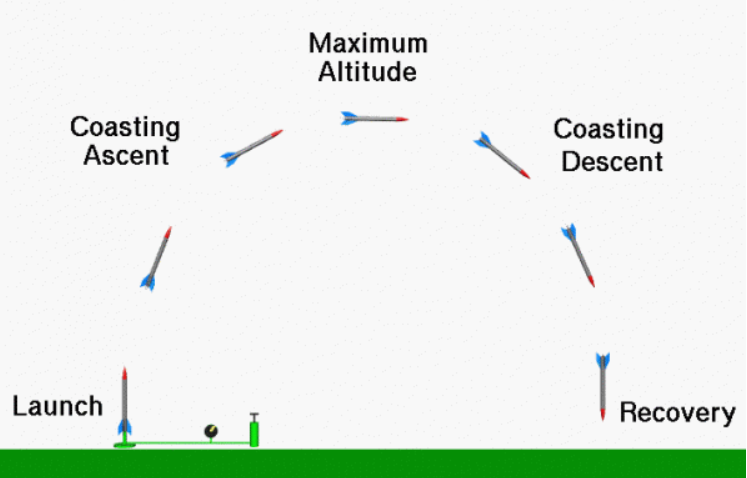
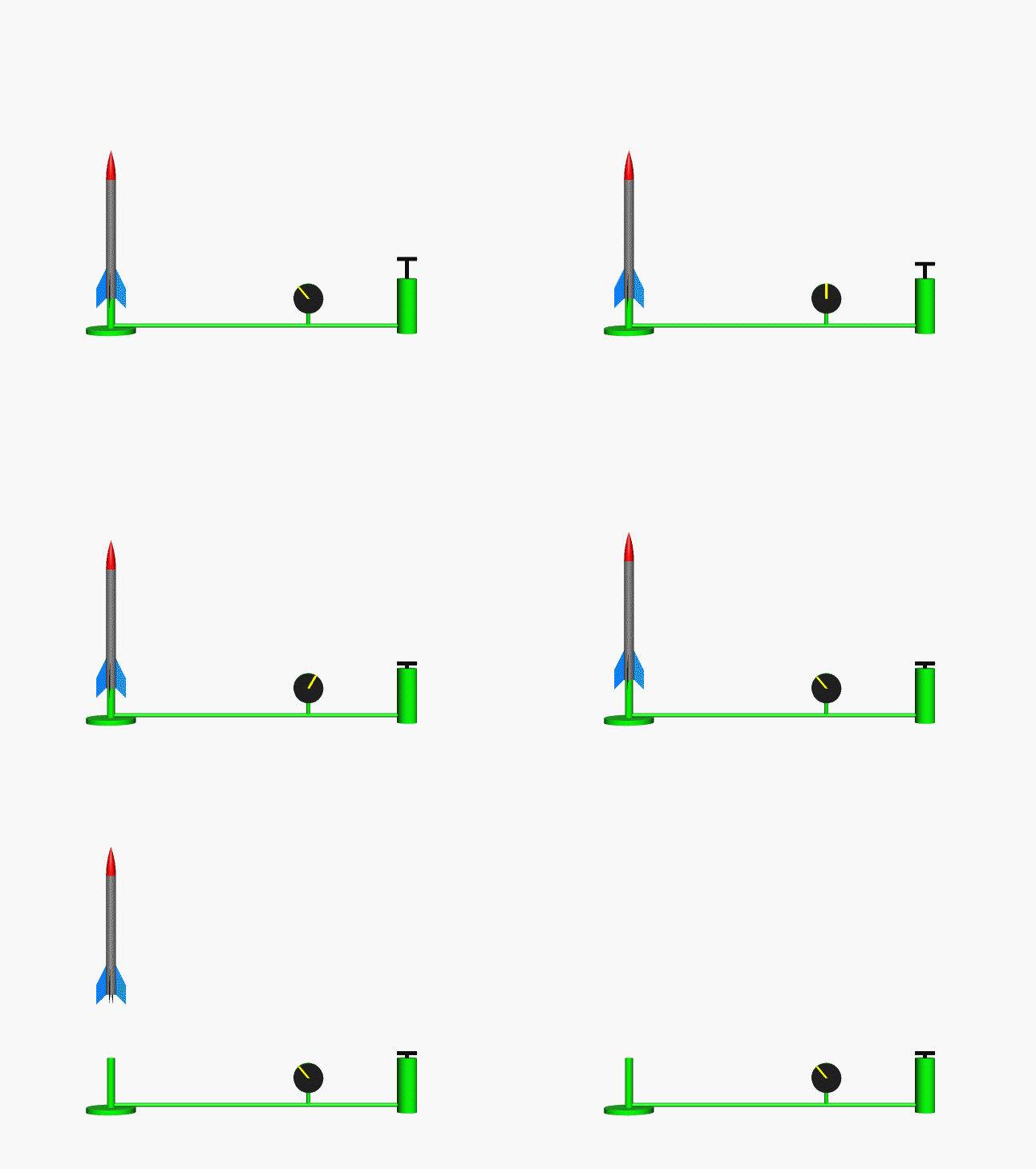
A launch tube and air pump pressurize the rocket, creating thrust that lifts it off the pad as it leaves the tube.
An air rocket has no engine, so its weight stays constant, unlike full-scale rockets. It relies on aerodynamics and launch tube stability.
Leaving the Pad
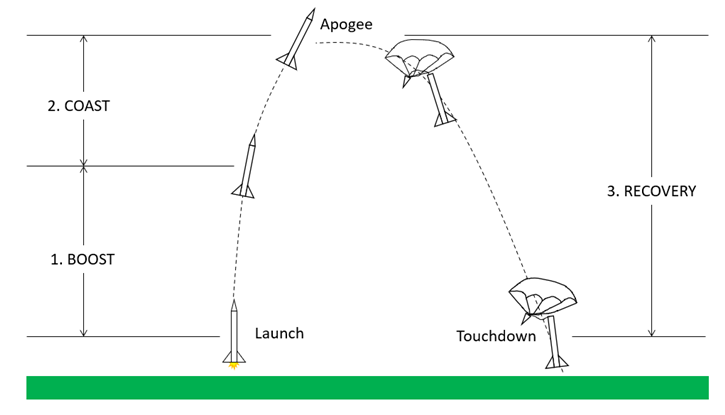
An air rocket coasts upward like a bullet but slows due to drag. It reaches maximum altitude, then falls back under gravity, usually without a parachute, ready for another launch.
On the Graphic
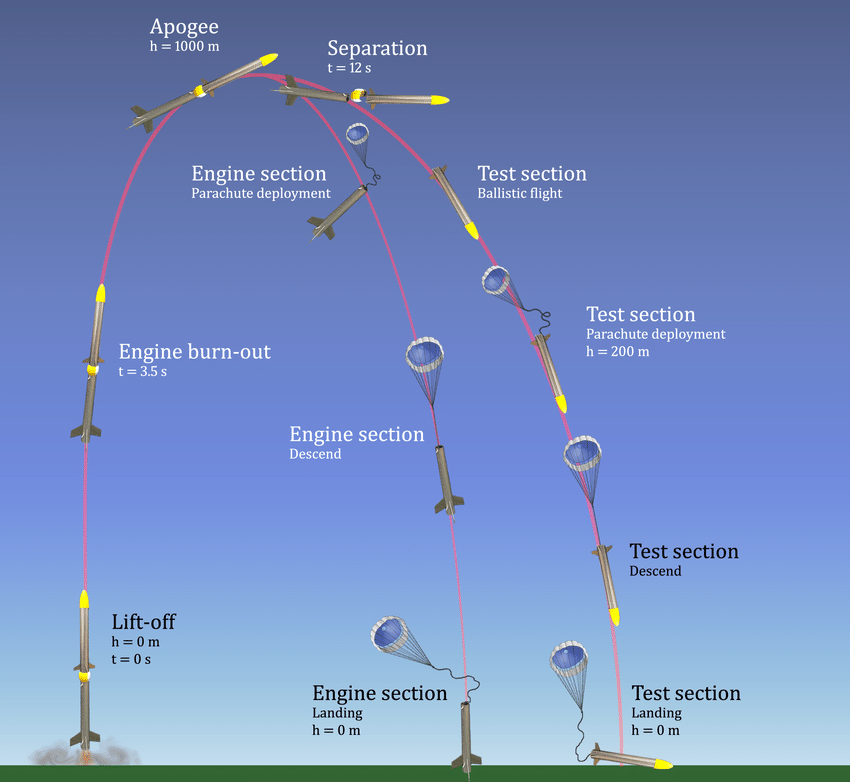
We show the flight path as a large arc through the sky. Ideally, the flight path would be straight up and down; this provides the largest maximum altitude. But air rockets often turn into the wind during flight because of an effect called weathercocking. The effect is the result of aerodynamic forces on the rocket and cause the maximum altitude to be slightly less than the optimum. The parabolic arc trajectory also occurs if the launch platform is tilted, and the rocket is launched at an angle from the vertical.
-
Pressurize
Air pump fills the rocket with pressure.
-
Launch
Pressurized air pushes the rocket upward.
-
Coast
Rocket ascends, slows due to drag.
-
Descend
Gravity pulls rocket back to the ground.
Air Rocket Launch
Stomp Rocket
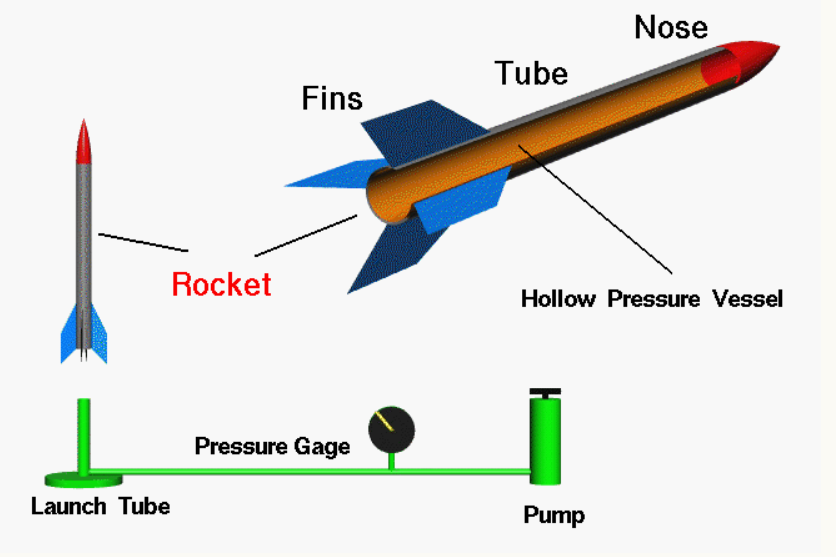
The first and simplest type of rocket that a student encounters is the compressed air, or stomp rocket. The air rocket system consists of two main parts, the launcher and the rocket.
Launcher
The launcher has a base to support the rocket during launch. A hollow launch tube is mounted perpendicular to the base and is inserted into the base of the rocket before launch. The launch tube is connected to an air pump by a hollow feeder line. The pump is used to pressurize the inside of the body tube to provide thrust for the rocket. We have attached a pressure gage to the feeder line to display the change in pressure in the system. For many air rockets, the pump is simply a cylinder which can be collapsed by striking with your hand or foot, which is where the “stomp” rocket got its name.
Rocket
The other part of the compressed air rocket system is the rocket itself. The rocket has a hollow body tube which is opened on one end and closed at the other end by the nose cone.Fins are attached to the bottom of the body tube to provide stability during the flight.
Terminal Velocity
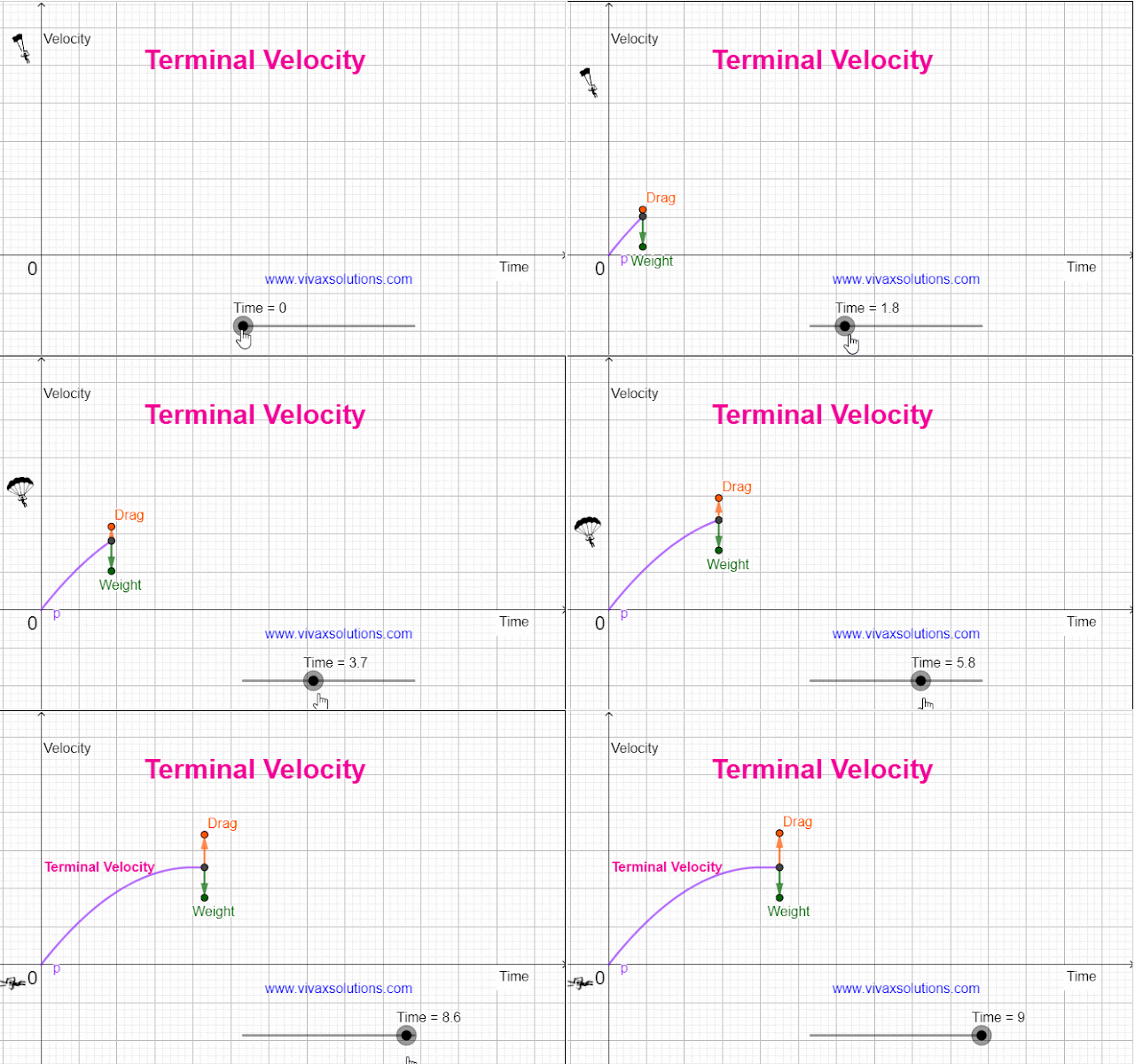
An object with larger area or higher drag reaches lower terminal velocity. Identical objects with different weights fall differently due to air resistance, unlike in a vacuum where all objects fall equally.
External Forces
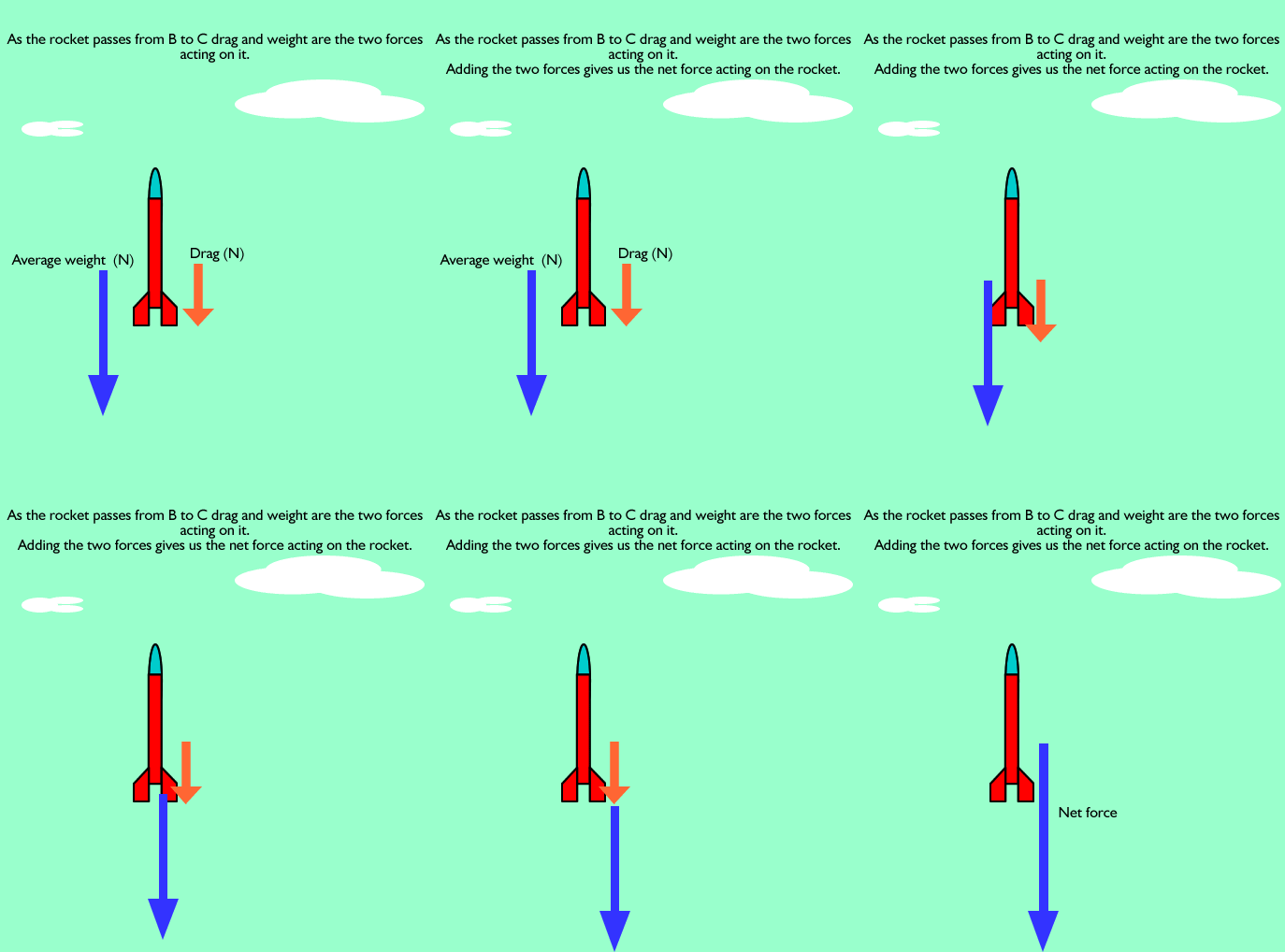
A falling object experiences gravity and air resistance. Newton’s second law states that force equals mass times acceleration, determining the object's motion when mass remains constant.
Drag
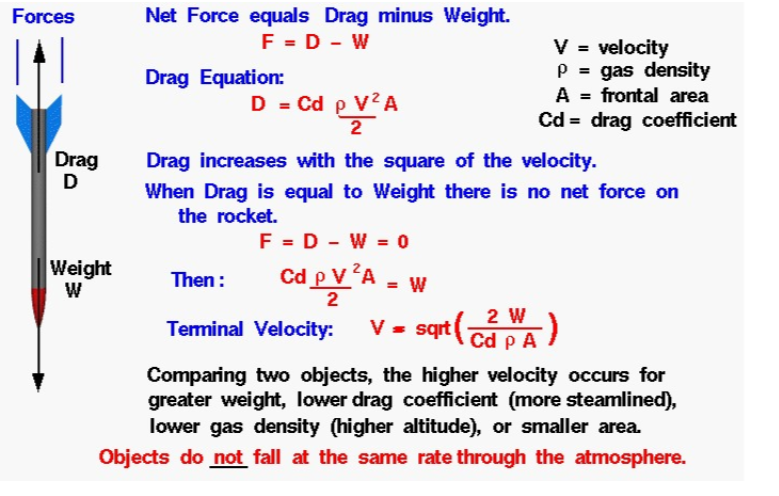
Drag increases with the square of the speed. So as an object falls, we quickly reach conditions where the drag becomes equal to the weight, if the weight is small. When drag is equal to weight, there is no net external force on the object and the vertical acceleration goes to zero. With no acceleration, the object falls at a constant velocity as described by Newton’s first law of motion. The constant vertical velocity is called the terminal velocity.
-
Net External Force
F = W−D, where 'W' is Weight and 'D' is Drag
Drag
, where 'Cd' is Drag Coefficient and 'ρ' is Gas Density
View -
Terminal Velocity
The terminal velocity equation tells us that an object with a large cross-sectional area or a high drag coefficient falls slower than an object with a small area or low drag coefficient.
View
Ballistic Flight Calculator
The study of model rockets, the flight of a baseball, or the “bend” of a soccer kick are excellent ways for students to learn the basics of forces and the response of an object to external forces. A ball in flight has no engine to produce continuous thrust and the resulting flight is similar to the flight of shell from a cannon, or a bullet from a gun. This type of flight is called ballistic flight.
Ballistic flight only occurs under the ideal conditions that weight is the only force acting on the object. There is no thrust and no aerodynamic drag acting on an object in ballistic flight. Such flight conditions would occur on the Moon, where there is no atmosphere to produce drag.
-

Aerodynamic Drag
On Earth, a baseball or soccer ball experiences aerodynamic drag, making its flight non-ballistic. Drag varies with velocity and air density, which change during flight due to weather and altitude. Exact flight equations are complex since drag depends on velocity squared and fluctuates throughout motion.
-

Vertical and Horizontal Angle
For ballistic flight, the ball is normally inclined at some angle to the vertical (or horizontal) as it is launched. We resolve the initial velocity into a vertical component V0 and a horizontal component U0.
\( \mathbf{U} = \mathbf{U}_0 \)
\( \mathbf{x} = \mathbf{U}_0 t \)
-
Vertical and Horizontal Angle(Contd.)
In the vertical plane, weight is the only external force acting on the object. Because the weight of the object is a constant, we can use the simple form of Newton’s second law to solve for the vertical motion:
\( -\mathbf{W} = \mathbf{F} = \mathbf{m} \mathbf{a} = \mathbf{m} \frac{d\mathbf{V}}{dt} \)
where W is the weight, m is the mass, V is the vertical velocity, t is the time, a is the acceleration, and F is the net external force.
Solving the equation: \[ \frac{\mathbf{dV}}{\mathbf{dt}} = \frac{-\mathbf{W}}{\mathbf{m}} = -\mathbf{g} \] \[ \mathbf{V} = \mathbf{V_0} - \mathbf{g} \mathbf{t} \]
Location at any time
Location at any time is found by integrating the previous equation: \[ \mathbf{\frac{dy}{dt} = V = V_0 - gt} \] \[ \mathbf{y = V_0 t - \frac{1}{2} g t^2} \]
-
At Maximum Height
At the highest point in the flight, the vertical velocity is zero. From the velocity equation we can determine the time at which this happens: \[ \mathbf{V = 0} \] \[ \mathbf{t = \frac{V_0}{g}} \]
The time to maximum altitude varies linearly with the launch velocity. Plugging this time into the altitude equation we obtain: \[ \mathbf{y = V_0 \frac{V_0}{g} - \frac{1}{2} g \left(\frac{V_0}{g} \right)^2} \] \[ \mathbf{y = \frac{1}{2} \frac{V_0^2}{g}} \]
The maximum altitude changes as the square of the launch velocity. Doubling the launch velocity produces four times the maximum altitude.