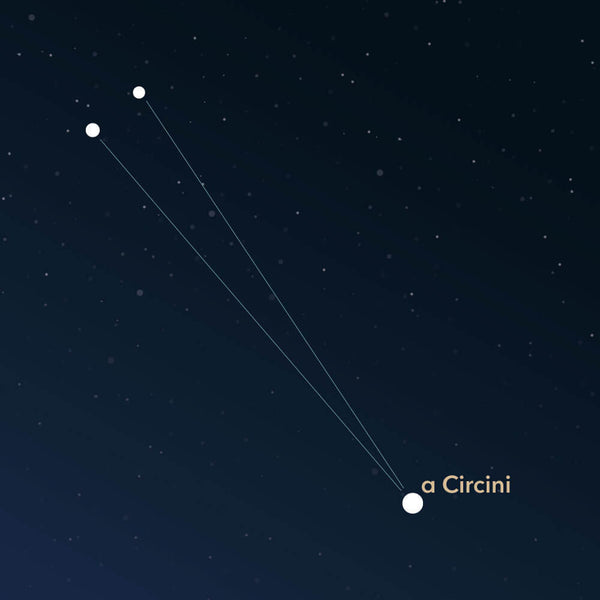
The Circinus symbolizes the drafting tool compass to draw circles. It is an inconspicuous and small southern constellation. It was first described by the astronomer Nicolas Louis de Lacaille in the mid-18th century. There are only a few deep-sky objects located in this area.
Hemisphere, Visibility, and area
The constellation of Circinus lies in the southern night sky and is visible from the entire southern hemisphere. North of the equator, it can be fully observed up to the 20th parallel. Meaning it is only visible to regions that are more southern than, for example, Tulum in Mexico, the northern part of Thailand, or the southernmost island of Hawaii.
The best time to observe the constellation is from March to July. It appears with an area of about 93 square degrees. Compared to all 88 constellations, Circinus is the fourth smallest constellation.
Circinus is not particularly prominent, as there are no bright stars in the area. The most shining star is α Circini (Alpha Circini), with an apparent magnitude of about 3.2. It lies at a distance of approximately 54 light-years from earth.
To find Circinus in the night sky, it is helpful to orient oneself with surrounding constellations. The Lupus, the Centaurus, the Musca, and the Apus are located in the immediate vicinity of the Circinus. The Triangulum Australe and the Norma are also directly adjacent.
Specialties in the constellation
The Milky Way runs through the area of the Circinus constellation, which is responsible for an interesting galaxy, an open star cluster, and a planetary nebula.
The galaxy is called the Circinus galaxy. It is an active spiral galaxy and is closer to us than any other known galaxy. Its distance to the Milky Way is estimated to be around 13 million light-years. It consists of two rings, with the outer one having a high concentration of gas and the inner one showing dense star formation. Both are concentrated around the center of the galaxy.
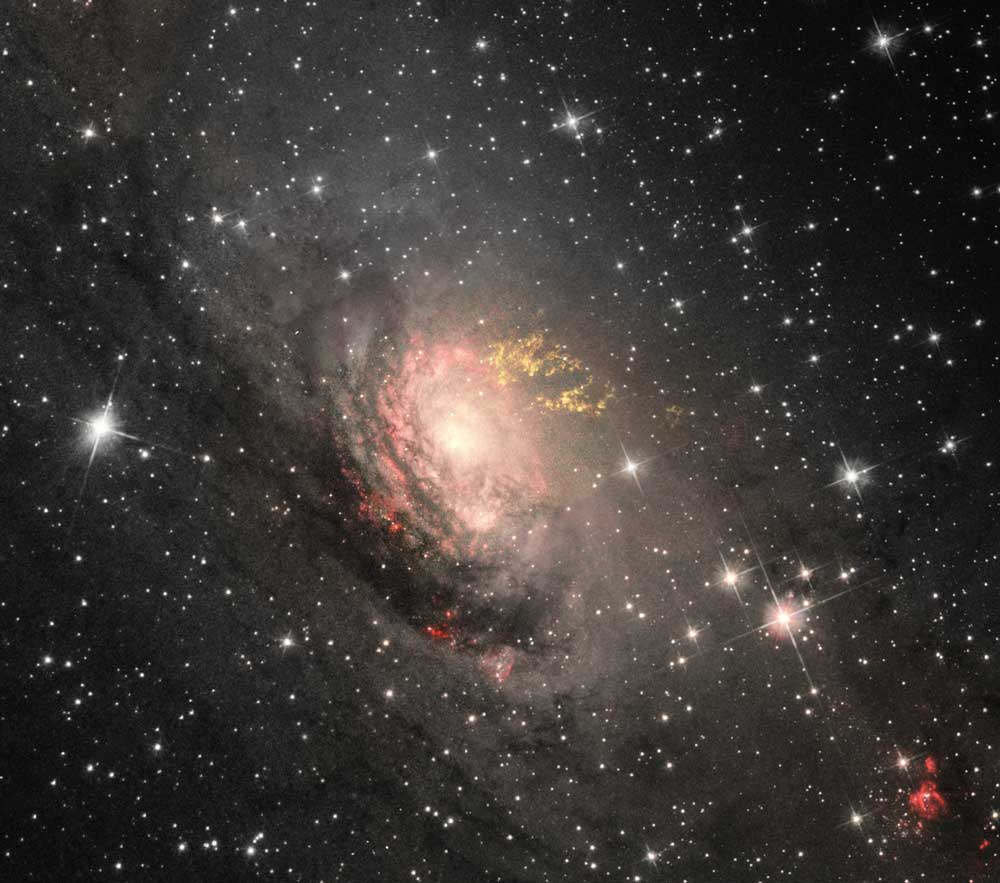 Circinus Galaxy
Mythology and history
In the mid-18th century, after the invention of the telescope, the French astronomer Nicolas Louis de Lacaille measured the coordinates of over 10,000 stars from the Cape of Good Hope near Cape Town in South Africa. He realized that not all sky areas are defined precisely, so he subsequently defined some new constellations.
While observing east of the star α Circini, he discovered some faint stars that reminded him of the arrangement of a compass. This prompted him to give the constellation the name Circinus. Circinus is the Latin translation for the "compass," a drawing tool.
It is the smallest of the constellations introduced by de Lacaille.